








Ocular surgery
Hyaluronic acid in ocular surgery


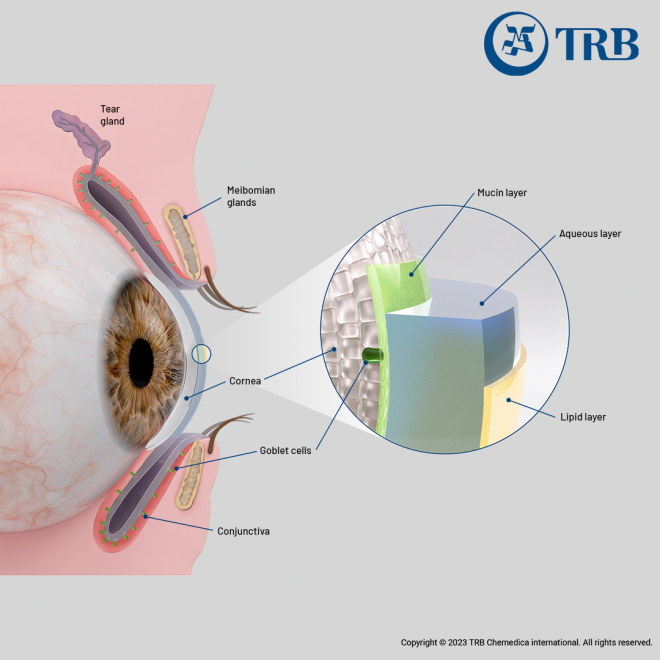
Dry Eye Disease is a common disorder of the eye surface in which the eyes don’t make enough tears or the tears evaporate too quickly, leading to ocular discomfort and/or visual disturbances.1,2
Signs and symptoms of Dry Eye Disease affect between 5% and 50% of the global population, resulting in significant visual, psychological and physical impact on quality of life, and considerable economic burden due to reduced work productivity.³
Dry eye disease is a multifactorial condition that can be triggered by various mechanisms. The current scientific consensus identifies three main etiologies of dry eye disease:1
Tear film deficiencies – disruption of any layer of the tear film (lipid, aqueous or mucin layer).
Eyelid anomalies – blink and lid closure anomalies or issues with the lid margin such as blepharitis or Meibomian gland dysfunction (MGD) might lead to the development of dry eye disease.
Ocular surface abnormalities – neural dysfunction or ocular surface cellular damage are also major causes of symptoms.
Possible causes of Dry Eye Disease include:4,5
There are many symptoms of Dry Eye Disease, and you may experience all or some of them:5,6

If you experience any of the symptoms of Dry Eye Disease it’s important you don’t wait until symptoms become severe before you seek help. It’s worth speaking to your pharmacist, doctor or your optometrist, who will be able to advise you and suggest medication such as eye drops depending on what’s causing your dry eye. If this doesn’t solve the problem they may refer you to an eye specialist, known as an ophthalmologist.


To preserve existing tears e.g., reduce screen use, reduce contact lens wear, increase humidity, avoid cigarette smoke

Use of artificial tears that enhance and/or stabilise the tear film

Through use of devices such as wrap-around glasses, or punctal plugs that block the tear drainage system.
For more than 25 years, TRB has been developing expertise in the management of dry eye disease, working closely with eye care professionals to support patients affected by ocular surface disorders.
This long‑standing experience is built around hyaluronic acid technology, a recognised approach to ocular surface hydration and protection. These solutions are designed to hydrate, protect and stabilise the ocular surface, helping to relieve symptoms associated with tear film instability.9

Hyaluronic acid is a naturally occurring polymer that is also present in the structures of the human eye. Its particular physical characteristics confer viscoelastic and water‑retaining properties, making it especially suitable for ocular lubrication.10
Thanks to these properties, hyaluronic acid forms a stable coating on the surface of the eye that is only slowly eliminated by blinking.11
This helps maintain prolonged hydration of the ocular surface while ensuring comfort during blinking. Different concentrations of hyaluronic acid, ranging from 0.1% to 0.3%, allow treatment approaches to be adapted to the specific needs of patients living with dry eye disease.

Wolffsohn JS, et al. TFOS DEWS III: Diagnostic Methodology. Am J Ophthalmol. 2025;279:387-450.
NICE CKS. Dry eye disease. January 2023. Available at: https://cks.nice.org.uk/topics/dry-eye-disease/. Accessed November 2025.
Stapleton F, Alves M, Bunya VY, et al. TFOS DEWS II epidemiology report. Ocul Surf. 2017;15:334-65.
NICE CKS. Dry eye disease. January 2023. Available at: https://cks.nice.org.uk/topics/dry-eye-disease/background-information/causes/. Accessed November 2025.
Golden MI, Meyer JJ, Zeppieri M, Patel BC. Dry eye syndrome. February 2024. StatPearls [Internet]. Available from: https://www.ncbi.nlm.nih.gov/books/NBK470411/. Accessed November 2025.
NICE CKS. Dry eye disease. January 2023. https://cks.nice.org.uk/topics/dry-eye-disease/diagnosis/diagnosis/. Accessed November 2025.
Jones L, Craig JP, Markoulli M, et al. TFOS DEWS III: management and therapy. Am J Ophthalmol 2025;279:289-386.
NICE CKS. Dry eye disease. January 2023. Available at: https://cks.nice.org.uk/topics/dry-eye-disease/management/management/. Accessed November 2025.
Yang YJ, Lee WY, Kim YJ, Hong YP. . A meta-analysis of the efficacy of hyaluronic acid eye drops for the treatment of dry eye syndrome. Int J Environ Res Public Health. 2021;18(5):2383.
Nakamura M, Hikida M, Nakano T, Ito S, Hamano T, Kinoshita S. Characterization of water retentive properties of hyaluronan. Cornea. 1993;12(5):433-6.
Mochizuki H, Yamada M, Hato S, Nishida T. Fluorophotometric measurement of the precorneal residence time of topically applied hyaluronic acid. Br J Ophthalmol. 2008;92(1):108-11.
This website is intended for an international audience and may include information about products that are not available in all countries or may be marketed under different trademarks, indications, or dosages. The content is provided for general information only and should not be considered medical advice or a substitute for guidance from a healthcare professional. Information on this website should not be interpreted as a solicitation or promotion of any medical device or drug.