





Tendinopathy
Explore causes, symptoms, and treatment


Osteoarthritis is the most common form of joint disease,¹ caused by the gradual breakdown of cartilage – the smooth, protective tissue that cushions the ends of bones.
Healthy cartilage allows bones to glide easily within a joint. In osteoarthritis:
The result is a cycle of pain and reduced movement, often progressing slowly over years.
As cartilage wears away, bones begin to rub against each other, leading to pain, stiffness, swelling, and loss of mobility.
Osteoarthritis can affect any joint, but it most often impacts the knees, hips, hands, and spine, limiting movement and quality of life for millions worldwide.²

Osteoarthritis develops due to a combination of biological, mechanical, and lifestyle factors:2–4
Understanding these factors helps patients and clinicians tailor prevention and management strategies.
Consult a healthcare professional if:
Early diagnosis can help slow disease progression and allow for more effective, tailored treatment.
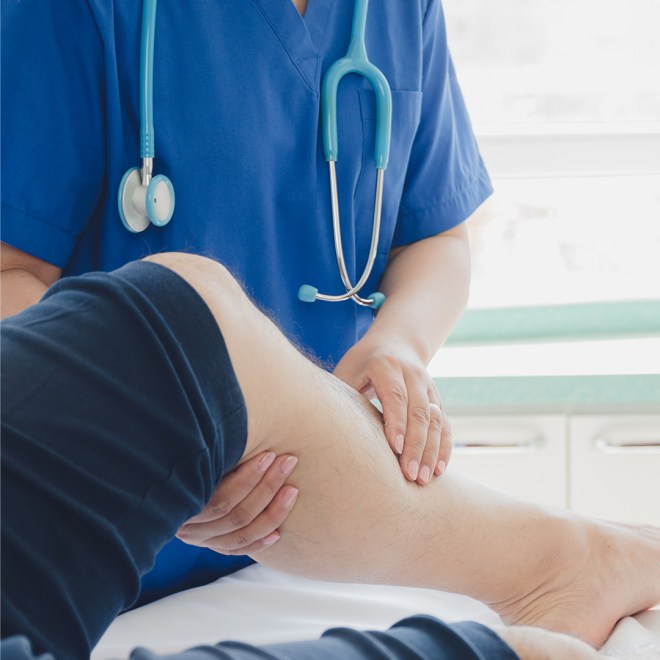
Effective management is “multimodal,” combining different therapies to support the management of symptoms and maintain joint function:2

Non-pharmacological therapies are the “cornerstone” of osteoarthritis care and should be maintained throughout the disease course.

Hyaluronic acid is a molecule naturally found in healthy joints, where it acts as a lubricant and shock absorber.5-7 In osteoarthritis, hyaluronic acid concentration declines, reducing the joint’s ability to glide smoothly.14 Injecting hyaluronic acid directly into the joint:
This makes hyaluronic acid therapy a valuable part of non-surgical osteoarthritis management.

Chen D, Shen J, Zhao W, et al. Osteoarthritis: toward a Comprehensive Understanding of Pathological Mechanism. Bone Research 2017;5(1):1–13.
GBD 2021 Osteoarthritis Collaborators. Global, regional, and national burden of osteoarthritis, 1990-2020 and projections to 2050: a systematic analysis for the Global Burden of Disease Study 2021. Lancet Rheumatol. 2023;5(9):e508–e522.
Altman RD. Early management of osteoarthritis. Am J Manag Care. 2010;16. Suppl Management:S41–7.
Chen D, Shen J, Zhao W, et al. Osteoarthritis: toward a comprehensive understanding of pathological mechanism. Bone Res. 2017;17(5):16044.
de Rezende MU, de Campos GC. Viscosupplementation. Rev Bras Ortop Engl Ed. 2012;47(2):160–164.
Sherman SL, Gudeman AS, Kelly JD 4th, et al. Mechanisms of Action of Intra-articular Hyaluronic Acid Injections for Knee Osteoarthritis: A Targeted Review of the Literature. Am J Sports Med. 2025;53(11):2771–2782.
Migliore A, Procopio S. Effectiveness and utility of hyaluronic acid in osteoarthritis. Clinical Cases in Mineral and Bone Metabolism 2015;12(1):31–33.
Ostenil® IFU. Available at: https://www.trbchemedica.de/mediathek/ostenil-beipackzettel-ifu-mdr/ (accessed March 2026).
This website is intended for an international audience and may include information about products that are not available in all countries or may be marketed under different trademarks, indications, or dosages. The content is provided for general information only and should not be considered medical advice or a substitute for guidance from a healthcare professional. Information on this website should not be interpreted as a solicitation or promotion of any medical device or drug.